
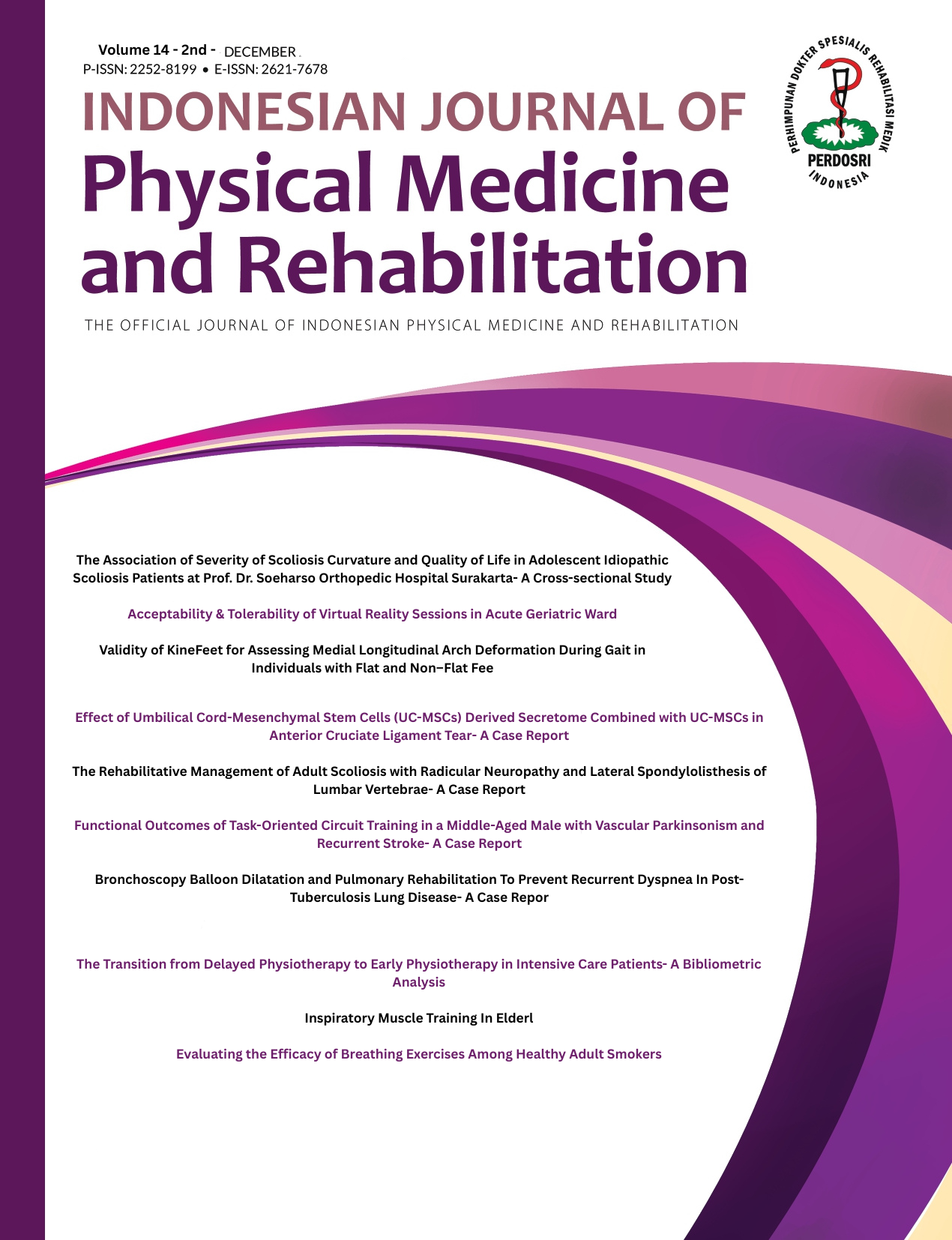
Evaluating the Efficacy of Breathing Exercises Among Healthy Adult Smokers
Article Sidebar
Published:
Dec 24, 2025
Keywords:
Breathing exercise, lung function, adult smokers, respiratory muscle training, pulmonary rehabilitation
Main Article Content
Abstract
Introduction: Smoking contributes significantly to preventable diseases such as chronic obstructive pulmonary disease. Breathing exercises have emerged as potential complementary therapies aimed at improving lung function among smokers. This study aims to evaluate the efficacy of breathing exercises in improving lung function among adult smokers.
Methods: A comprehensive search of peer-reviewed literature from PubMed, Semantic Scholar, and Google Scholar from the past ten years. Eligible studies included randomized controlled trials (RCTs), quasi-experimental studies, and pilot studies on the impact of breathing exercises on lung function in adult smokers. Narrative data synthesis was conducted.
Results: Nine studies met the inclusion criteria. Diaphragmatic breathing, balloon blowing, and feedback breathing exercises significantly improved pulmonary parameters, including the FEV1/FVC ratio, tidal volume, inspiratory reserve volume, inspiratory capacity, vital capacity, and respiratory muscle activity. One study shows that FVC (3.77 ± 0.30) and FEV1 (3.13 ± 0.54) significantly improved after exercise (p < 0.05).
Conclusions: Breathing techniques can be a beneficial complementary treatment for improving lung function, particularly in terms of vagus nerve control and the balance between sympathetic and parasympathetic systems, as well as the kinesiology and physiology of the lung’s dynamics. The findings are limited by study design, sample size, and intervention protocols. Future research should focus on high-quality randomized controlled trials (RCTs) with long-term follow-ups to evaluate the long-term effects.
Keyword: Breathing exercise, lung function, adult smokers, respiratory muscle training, pulmonary rehabilitation
Methods: A comprehensive search of peer-reviewed literature from PubMed, Semantic Scholar, and Google Scholar from the past ten years. Eligible studies included randomized controlled trials (RCTs), quasi-experimental studies, and pilot studies on the impact of breathing exercises on lung function in adult smokers. Narrative data synthesis was conducted.
Results: Nine studies met the inclusion criteria. Diaphragmatic breathing, balloon blowing, and feedback breathing exercises significantly improved pulmonary parameters, including the FEV1/FVC ratio, tidal volume, inspiratory reserve volume, inspiratory capacity, vital capacity, and respiratory muscle activity. One study shows that FVC (3.77 ± 0.30) and FEV1 (3.13 ± 0.54) significantly improved after exercise (p < 0.05).
Conclusions: Breathing techniques can be a beneficial complementary treatment for improving lung function, particularly in terms of vagus nerve control and the balance between sympathetic and parasympathetic systems, as well as the kinesiology and physiology of the lung’s dynamics. The findings are limited by study design, sample size, and intervention protocols. Future research should focus on high-quality randomized controlled trials (RCTs) with long-term follow-ups to evaluate the long-term effects.
Keyword: Breathing exercise, lung function, adult smokers, respiratory muscle training, pulmonary rehabilitation
Article Details
How to Cite
Lubis, P. A., Fannissa, K. A., & Widjanantie, S. C. (2025). Evaluating the Efficacy of Breathing Exercises Among Healthy Adult Smokers. Indonesian Journal of Physical Medicine and Rehabilitation, 14(2), 311 - 319. https://doi.org/10.36803/indojpmr.v14i2.481
Section
Literature Review

This work is licensed under a Creative Commons Attribution 4.0 International License.
All articles published in the Indonesian Journal of Physical Medicine and Rehabilitation (IJPMR) are licensed under the Creative Commons Attribution 4.0 International License (CC BY 4.0). This license allows others to share, copy, distribute, adapt, and build upon the work for any purpose, including commercial use, as long as proper attribution is given to the original authors.

Indonesian Journal of Physical Medicine and Rehabilitation is Full license terms: https://creativecommons.org/licenses/by/4.0/
References
1. Samet JM. Tobacco smoking: the leading cause of preventable disease worldwide. Thorac Surg Clin. 2013;23(2):103-112. doi:10.1016/j.thorsurg.2013.01.009
2. Ziedonis D, Kalman D, Kolodziej M, Johnson CW, Kim S. Tobacco addiction and psychological comorbidities. In: Pagoto S, ed. Psychological Co-Morbidities of Physical Illness: A Behavioral Medicine Perspective. Springer New York; 2011:207-232. doi:10.1007/978-1-4419-0029-6_5
3. Nhan C, Windle SB, Eisenberg MJ, et al. A systematic review of combination therapies for smoking cessation. Can J Gen Intern Med. 2015;10(2):25-36. doi:10.22374/cjgim.v10i2.29
4. Yancey JR, Chaffee DM. The role of breathing exercises in the treatment of COPD. Am Fam Physician. 2014;89(1):15-16.
5. Murray JF, Buist AS. Respiratory Disorders Related to Smoking Tobacco.; 2015. doi:10.1159/000369327
6. John Cecily DHS, Cecily J, Alotaibi A. Effectiveness of breathing exercises on pulmonary function parameters and quality of life of patients with chronic obstructive pulmonary disease. Eff Breath Exerc Pulm funtion parameters Qual Life patients with Chronic Obstr Pulm Dis. 2013;803:80-85.
7. Cea Ugarte JI, Gonzalez-Pinto Arrillaga A, Cabo Gonzalez OM. Efficacy of the controlled breathing therapy on stress: biological correlates. preliminary study. Rev Enferm. 2010;33(5):48-54.
8. Haddaway NR, Page MJ, Pritchard CC, McGuinness LA. PRISMA 2020: An R package and Shiny app for producing PRISMA 2020-compliant flow diagrams, with interactivity for optimised digital transparency and Open Synthesis. Campbell Syst Rev. 2022;18(2):e1230. doi:https://doi.org/10.1002/cl2.1230
9. Jun H-J, Kim K-J, Nam K-W, Kim C-H. Effects of breathing exercises on lung capacity and muscle activities of elderly smokers. J Phys Ther Sci. 2016;28(6):1681-1685. doi:10.1589/jpts.28.1681
10. Jun HJ, Kim KJ. Comparison of the effects of respiratory exercise between smokers and non-smokers on pulmonary function and muscle activity of rectus abdominis with function and muscle activity of rectus abdominis with the elderly people. J Int Acad Phys Ther Res. 2017;8(2):1146-1151. doi:10.20540/JIAPTR.2017.8.2.1146
11. Seo K, Park SH, Park K. Effects of diaphragm respiration exercise on pulmonary function of male smokers in their twenties. J Phys Ther Sci. 2015;27(7):2313-2315. doi:10.1589/jpts.27.2313
12. Tharani. G, Kamatchi. K, Yuvarani. G, Kumar R. To compare the effect of acapella and diaphragmatic breathing exercise in smokers to increase in vital capacity. Int J Med Exerc Sci. 2023;09(03):1607-1617. doi:10.36678/IJMAES.2023.V09I03.005
13. Kanniappan V, Manivannan V. Efficacy of balloon blowing exercise on peak expiratory flow rate in young adult smokers. J Lifestyle Med. 2020;10(2):116-120. doi:10.15280/jlm.2020.10.2.116
14. Awan W, Abid N, Rao A, Babur M, Ansari M. Effect of deep breathing exercises in healthy smokers: a pilot study. J Pak Med Assoc. Published online 2020:1. doi:10.5455/JPMA.16551
15. Bostanci Ö, Mayda H, Yılmaz C, Kabadayı M, Yılmaz AK, Özdal M. Inspiratory muscle training improves pulmonary functions and respiratory muscle strength in healthy male smokers. Respir Physiol Neurobiol. 2019;264:28-32. doi:10.1016/j.resp.2019.04.001
16. AktuÄŸ ZB, PiÅŸkin NE, Kutlu Z, Yavuz G, Ä°biÅŸ S, Aka H. The effect of deviced respiratory muscle exercises applied to smokers and non-smokers on respiratory functions. J Educ Recreat Patterns. 2023;4(1):87-98. doi:10.53016/jerp.v4i1.99
17. Apoorva Bhatnagar, Sunita Sharma. Effectiveness of chest PNF and breathing exercises on pulmonary function and chest expansion in male smokers. Indian J Physiother Occup Ther - An Int J. 2021;16(1):159-168. doi:10.37506/ijpot.v16i1.17790
18. McGuinness LA, Higgins JPT. Risk-of-bias VISualization (robvis): An R package and Shiny web app for visualizing risk-of-bias assessments. Res Synth Methods. n/a(n/a). doi:10.1002/jrsm.1411
19. Vieira DSR, Mendes LPS, Elmiro NS, Velloso M, Britto RR, Parreira VF. Breathing exercises: influence on breathing patterns and thoracoabdominal motion in healthy subjects. Brazilian J Phys Ther. 2014;18(6):544-552. doi:10.1590/bjpt-rbf.2014.0048
20. Inal-Ince D, Cakmak A. Kinesiology of respiration. In: Comparative Kinesiology of the Human Body. Elsevier; 2020:353-363. doi:10.1016/B978-0-12-812162-7.00019-9
21. Seo K, Cho M. The effects of a balloon-blowing exercise in a 90/90 bridge position using a ball on the pulmonary function of females in their twenties. J Phys Ther Sci. 2018;30(10):1267-1270. doi:10.1589/jpts.30.1267
22. González-Ãlvarez FJ, Valenza MC, Cabrera-Martos I, Torres-Sánchez I, Valenza-Demet G. Effects of a diaphragm stretching technique on pulmonary function in healthy participants: A randomized-controlled trial. Int J Osteopath Med. 2015;18(1):5-12. doi:10.1016/j.ijosm.2014.08.001
23. Cabral LF, D’Elia TDC, Marins DDS, Zin WA, Guimarães FS. Pursed lip breathing improves exercise tolerance in COPD: a randomized crossover study. Eur J Phys Rehabil Med. 2015;51(1):79-88.
24. Tian N, Liu G, Song R. Effect of deep breathing on interaction between sympathetic and parasympathetic activities. In: 2018 IEEE International Conference on Cyborg and Bionic Systems (CBS). IEEE; 2018:628-631. doi:10.1109/CBS.2018.8612291
25. Cheng KS, Lee PF. A physiological/model study on the effects of deep breathing on the respiration rate, oxygen saturation, and cerebral oxygen delivery in humans. Neurophysiology. 2018;50(5):351-356. doi:10.1007/S11062-019-09761-4
26. Goutama E, Chandra Widjanantie S. The effect of diaphragm breathing exercises on physiological and psychological stress. Indones J Phys Med Rehabil. 2023;12(02):197-205. doi:10.36803/indojpmr.v12i02.344
27. Neves CDC, Lacerda ACR, Lage VKS, et al. Oxidative stress and skeletal muscle dysfunction are present in healthy smokers. Brazilian J Med Biol Res. 2016;49(11). doi:10.1590/1414-431x20165512
28. Bhardwaj P, Bhardwaj R, Singh P, Mishra D. Effect of one month diaphragmatic breathing on peak expiratory flow rate and breath holding time. Int J Med Biomed Stud. 2021;5(9). doi:10.32553/ijmbs.v5i9.2202
29. Yoon J-M, Im S-C, Kim K. Effects of diaphragmatic breathing and pursed lip breathing exercises on the pulmonary function and walking endurance in patients with chronic stroke: a randomised controlled trial. Int J Ther Rehabil. 2022;29(8):1-11. doi:10.12968/ijtr.2021.0027
30. Mushtaq B, Afzal H, Iqbal M, Aftab A. Effects of resistive diaphragmatic training on the pulmonary functions in patients with chronic stroke. Pakistan J Med Heal Sci. 2023;17(1):79-82. doi:10.53350/pjmhs202317179
31. Siva Jyothi N, Senthil Selvam P, Ahmedullah M, Yatheendra KG, Subramanian SS, Paul J. Effectiveness of PNF stretch of pectoralis major muscle on pulmonary function in COPD patients. Int J Health Sci (Qassim). Published online May 31, 2022:13332-13341. doi:10.53730/ijhs.v6nS1.8464
32. Tayade V, Vardhan G.D. V. Effect of aerobika device versus acapella device on sputum volume and lung functions in chronic obstructive lung disease patients- a research protocol. J Clin DIAGNOSTIC Res. 2023;17. doi:10.7860/JCDR/2023/58056.17769
33. Hichkad S, Ganesh BR. Effect of blow bottle device and flutter on functional capacity, dyspnea, fatigue, and peak expiratory flow rate in mild to moderate COPD patients: a comparative study. Indian J Respir Care¦ Vol. 2021;10(3):295.
34. Jaiswal KK, Das AK. Effectiveness of acapella, flutter and active cycle of breathing technique on lung function in COPD patients: A comparative study. Indian J Physiother Occup Ther. 2019;13:71.
35. Huang Z, Li Z, Yan M, et al. Effect of respiratory muscle training in patients with stable chronic obstructive pulmonary disease: A systematic review and meta-analysis. Heliyon. 2024;10(7):e28733. doi:10.1016/j.heliyon.2024.e28733
36. Kwak S. Inspiratory muscle training. Ann Cardiopulm Rehabil. 2023;3(1):9-18. doi:10.53476/acpr.2023.3.1.9
37. Noor R, Zia W, Hayyat M, Ishriaq I, Shakoor A, Khalid M. Effects of inspiratory muscles trainer in pulmonary rehabilitation program among COPD patients. Pakistan J Med Heal Sci. 2022;16(12):122-124. doi:10.53350/pjmhs20221612122
38. Oliveira K, Breda M, Ambrozin A. Effects of two different inspiratory muscle training devices on respiratory muscle strength, cardiopulmonary functional capacity, and quality of life of COPD patients. Man Ther Posturology Rehabil J. 2022;20:1-7. doi:10.17784/mtprehabjournal.2022.20.1258
39. Powell T, Williams EM. Effect of resistive load on the inspiratory work and power of breathing during exertion. PLoS One. 2012;7(11):e49681.
2. Ziedonis D, Kalman D, Kolodziej M, Johnson CW, Kim S. Tobacco addiction and psychological comorbidities. In: Pagoto S, ed. Psychological Co-Morbidities of Physical Illness: A Behavioral Medicine Perspective. Springer New York; 2011:207-232. doi:10.1007/978-1-4419-0029-6_5
3. Nhan C, Windle SB, Eisenberg MJ, et al. A systematic review of combination therapies for smoking cessation. Can J Gen Intern Med. 2015;10(2):25-36. doi:10.22374/cjgim.v10i2.29
4. Yancey JR, Chaffee DM. The role of breathing exercises in the treatment of COPD. Am Fam Physician. 2014;89(1):15-16.
5. Murray JF, Buist AS. Respiratory Disorders Related to Smoking Tobacco.; 2015. doi:10.1159/000369327
6. John Cecily DHS, Cecily J, Alotaibi A. Effectiveness of breathing exercises on pulmonary function parameters and quality of life of patients with chronic obstructive pulmonary disease. Eff Breath Exerc Pulm funtion parameters Qual Life patients with Chronic Obstr Pulm Dis. 2013;803:80-85.
7. Cea Ugarte JI, Gonzalez-Pinto Arrillaga A, Cabo Gonzalez OM. Efficacy of the controlled breathing therapy on stress: biological correlates. preliminary study. Rev Enferm. 2010;33(5):48-54.
8. Haddaway NR, Page MJ, Pritchard CC, McGuinness LA. PRISMA 2020: An R package and Shiny app for producing PRISMA 2020-compliant flow diagrams, with interactivity for optimised digital transparency and Open Synthesis. Campbell Syst Rev. 2022;18(2):e1230. doi:https://doi.org/10.1002/cl2.1230
9. Jun H-J, Kim K-J, Nam K-W, Kim C-H. Effects of breathing exercises on lung capacity and muscle activities of elderly smokers. J Phys Ther Sci. 2016;28(6):1681-1685. doi:10.1589/jpts.28.1681
10. Jun HJ, Kim KJ. Comparison of the effects of respiratory exercise between smokers and non-smokers on pulmonary function and muscle activity of rectus abdominis with function and muscle activity of rectus abdominis with the elderly people. J Int Acad Phys Ther Res. 2017;8(2):1146-1151. doi:10.20540/JIAPTR.2017.8.2.1146
11. Seo K, Park SH, Park K. Effects of diaphragm respiration exercise on pulmonary function of male smokers in their twenties. J Phys Ther Sci. 2015;27(7):2313-2315. doi:10.1589/jpts.27.2313
12. Tharani. G, Kamatchi. K, Yuvarani. G, Kumar R. To compare the effect of acapella and diaphragmatic breathing exercise in smokers to increase in vital capacity. Int J Med Exerc Sci. 2023;09(03):1607-1617. doi:10.36678/IJMAES.2023.V09I03.005
13. Kanniappan V, Manivannan V. Efficacy of balloon blowing exercise on peak expiratory flow rate in young adult smokers. J Lifestyle Med. 2020;10(2):116-120. doi:10.15280/jlm.2020.10.2.116
14. Awan W, Abid N, Rao A, Babur M, Ansari M. Effect of deep breathing exercises in healthy smokers: a pilot study. J Pak Med Assoc. Published online 2020:1. doi:10.5455/JPMA.16551
15. Bostanci Ö, Mayda H, Yılmaz C, Kabadayı M, Yılmaz AK, Özdal M. Inspiratory muscle training improves pulmonary functions and respiratory muscle strength in healthy male smokers. Respir Physiol Neurobiol. 2019;264:28-32. doi:10.1016/j.resp.2019.04.001
16. AktuÄŸ ZB, PiÅŸkin NE, Kutlu Z, Yavuz G, Ä°biÅŸ S, Aka H. The effect of deviced respiratory muscle exercises applied to smokers and non-smokers on respiratory functions. J Educ Recreat Patterns. 2023;4(1):87-98. doi:10.53016/jerp.v4i1.99
17. Apoorva Bhatnagar, Sunita Sharma. Effectiveness of chest PNF and breathing exercises on pulmonary function and chest expansion in male smokers. Indian J Physiother Occup Ther - An Int J. 2021;16(1):159-168. doi:10.37506/ijpot.v16i1.17790
18. McGuinness LA, Higgins JPT. Risk-of-bias VISualization (robvis): An R package and Shiny web app for visualizing risk-of-bias assessments. Res Synth Methods. n/a(n/a). doi:10.1002/jrsm.1411
19. Vieira DSR, Mendes LPS, Elmiro NS, Velloso M, Britto RR, Parreira VF. Breathing exercises: influence on breathing patterns and thoracoabdominal motion in healthy subjects. Brazilian J Phys Ther. 2014;18(6):544-552. doi:10.1590/bjpt-rbf.2014.0048
20. Inal-Ince D, Cakmak A. Kinesiology of respiration. In: Comparative Kinesiology of the Human Body. Elsevier; 2020:353-363. doi:10.1016/B978-0-12-812162-7.00019-9
21. Seo K, Cho M. The effects of a balloon-blowing exercise in a 90/90 bridge position using a ball on the pulmonary function of females in their twenties. J Phys Ther Sci. 2018;30(10):1267-1270. doi:10.1589/jpts.30.1267
22. González-Ãlvarez FJ, Valenza MC, Cabrera-Martos I, Torres-Sánchez I, Valenza-Demet G. Effects of a diaphragm stretching technique on pulmonary function in healthy participants: A randomized-controlled trial. Int J Osteopath Med. 2015;18(1):5-12. doi:10.1016/j.ijosm.2014.08.001
23. Cabral LF, D’Elia TDC, Marins DDS, Zin WA, Guimarães FS. Pursed lip breathing improves exercise tolerance in COPD: a randomized crossover study. Eur J Phys Rehabil Med. 2015;51(1):79-88.
24. Tian N, Liu G, Song R. Effect of deep breathing on interaction between sympathetic and parasympathetic activities. In: 2018 IEEE International Conference on Cyborg and Bionic Systems (CBS). IEEE; 2018:628-631. doi:10.1109/CBS.2018.8612291
25. Cheng KS, Lee PF. A physiological/model study on the effects of deep breathing on the respiration rate, oxygen saturation, and cerebral oxygen delivery in humans. Neurophysiology. 2018;50(5):351-356. doi:10.1007/S11062-019-09761-4
26. Goutama E, Chandra Widjanantie S. The effect of diaphragm breathing exercises on physiological and psychological stress. Indones J Phys Med Rehabil. 2023;12(02):197-205. doi:10.36803/indojpmr.v12i02.344
27. Neves CDC, Lacerda ACR, Lage VKS, et al. Oxidative stress and skeletal muscle dysfunction are present in healthy smokers. Brazilian J Med Biol Res. 2016;49(11). doi:10.1590/1414-431x20165512
28. Bhardwaj P, Bhardwaj R, Singh P, Mishra D. Effect of one month diaphragmatic breathing on peak expiratory flow rate and breath holding time. Int J Med Biomed Stud. 2021;5(9). doi:10.32553/ijmbs.v5i9.2202
29. Yoon J-M, Im S-C, Kim K. Effects of diaphragmatic breathing and pursed lip breathing exercises on the pulmonary function and walking endurance in patients with chronic stroke: a randomised controlled trial. Int J Ther Rehabil. 2022;29(8):1-11. doi:10.12968/ijtr.2021.0027
30. Mushtaq B, Afzal H, Iqbal M, Aftab A. Effects of resistive diaphragmatic training on the pulmonary functions in patients with chronic stroke. Pakistan J Med Heal Sci. 2023;17(1):79-82. doi:10.53350/pjmhs202317179
31. Siva Jyothi N, Senthil Selvam P, Ahmedullah M, Yatheendra KG, Subramanian SS, Paul J. Effectiveness of PNF stretch of pectoralis major muscle on pulmonary function in COPD patients. Int J Health Sci (Qassim). Published online May 31, 2022:13332-13341. doi:10.53730/ijhs.v6nS1.8464
32. Tayade V, Vardhan G.D. V. Effect of aerobika device versus acapella device on sputum volume and lung functions in chronic obstructive lung disease patients- a research protocol. J Clin DIAGNOSTIC Res. 2023;17. doi:10.7860/JCDR/2023/58056.17769
33. Hichkad S, Ganesh BR. Effect of blow bottle device and flutter on functional capacity, dyspnea, fatigue, and peak expiratory flow rate in mild to moderate COPD patients: a comparative study. Indian J Respir Care¦ Vol. 2021;10(3):295.
34. Jaiswal KK, Das AK. Effectiveness of acapella, flutter and active cycle of breathing technique on lung function in COPD patients: A comparative study. Indian J Physiother Occup Ther. 2019;13:71.
35. Huang Z, Li Z, Yan M, et al. Effect of respiratory muscle training in patients with stable chronic obstructive pulmonary disease: A systematic review and meta-analysis. Heliyon. 2024;10(7):e28733. doi:10.1016/j.heliyon.2024.e28733
36. Kwak S. Inspiratory muscle training. Ann Cardiopulm Rehabil. 2023;3(1):9-18. doi:10.53476/acpr.2023.3.1.9
37. Noor R, Zia W, Hayyat M, Ishriaq I, Shakoor A, Khalid M. Effects of inspiratory muscles trainer in pulmonary rehabilitation program among COPD patients. Pakistan J Med Heal Sci. 2022;16(12):122-124. doi:10.53350/pjmhs20221612122
38. Oliveira K, Breda M, Ambrozin A. Effects of two different inspiratory muscle training devices on respiratory muscle strength, cardiopulmonary functional capacity, and quality of life of COPD patients. Man Ther Posturology Rehabil J. 2022;20:1-7. doi:10.17784/mtprehabjournal.2022.20.1258
39. Powell T, Williams EM. Effect of resistive load on the inspiratory work and power of breathing during exertion. PLoS One. 2012;7(11):e49681.